Quick Summary
Choose a chip seal contractor by first confirming your pavement suits chip seal, then verifying licensing, insurance, and comparable commercial experience. Score every bid on a weighted scale covering technical proposal, phasing, and contractual terms, not price alone. A cheap bid that omits surface preparation or application rates is incomplete, not a bargain.
- Confirm rutting is under 3/8 inch before considering chip seal, per the FHWA checklist.
- Verify state licensing, a certificate of insurance naming your property, and workers’ compensation coverage.
- Ask for references from at least three comparable commercial projects.
- Weight the scorecard so technical proposal and commercial terms outweigh price alone.
- Require unit-basis bids so line items for prep, binder, aggregate, and traffic control can be compared.
Table of Contents
- Why Contractor Selection Matters More for Chip Seal Than Most Paving Work
- First Check Whether Chip Seal Fits Your Pavement
- Vetting Experience, Licensing, Insurance, and Credentials
- Questions to Ask a Paving Contractor Before You Hire
- Commercial Asphalt Contractor Checklist for Scoring Bids
- Chip Seal Project Timeline and Phasing for a Working Business
- Understanding Chip Seal Paving Cost Without Chasing the Lowest Bid
- Booking Your Site Assessment With Global Paving
- Frequently Asked Questions
Why Contractor Selection Matters More for Chip Seal Than Most Paving Work
Choosing a commercial chip seal contractor is a harder call than choosing a general paving company, since the right chip seal contractor is judged on technical detail rather than price alone.
Contractor selection is often the first decision that shapes how a chip seal performs. Commercial buyers should ask how much of a contractor’s own work looks like their project.
Chip seal also has a narrower margin for error than many buyers expect. The treatment works only on the right pavement, in the right weather, with the right materials.
First Check Whether Chip Seal Fits Your Pavement
Chip seal is not appropriate for every pavement. Before you compare contractors, confirm the treatment suits your surface.
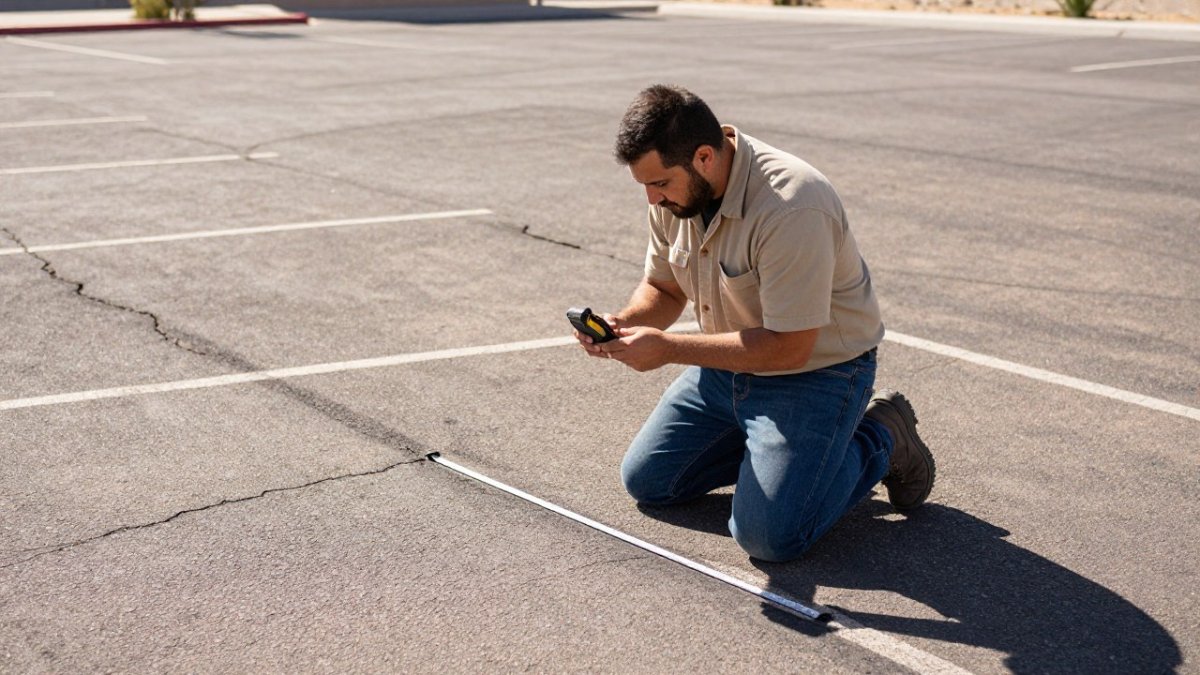
The Federal Highway Administration’s checklist gives a concrete screen. It says to verify that a project is a good candidate for chip sealing and limits existing rutting to less than 3/8 inch (FHWA Chip Seal Checklist).
Ask a contractor to inspect the surface and explain why chip seal does or does not fit. A good answer addresses cracking, rutting, base condition, and drainage.
For background on the treatment itself, our Chip Seal service page explains what the process involves. You can also review How to Choose Chip Seal Aggregate Size: 7 Steps to understand how sizing affects the finished surface.
Vetting Experience, Licensing, Insurance, and Credentials
Experience matters, but relevant experience matters more.
Verify the paperwork before you sign anything.
Credentials alone do not prove quality. Ask who will supervise the crew on your site and whether the company self-performs the work or subcontracts it.
Our Asphalt Paving page outlines the paving services we handle, which can help you compare the scope of work across bids.
Questions to Ask a Paving Contractor Before You Hire
The right questions reveal how a contractor actually works. Use them during the bidding process and compare answers across all bidders.
- Pavement assessment: What condition issues did you find, and why is chip seal the right treatment?
- Aggregate and binder: What aggregate size and binder type do you recommend for our traffic, and why?
- Crew: Who supervises the work on site, and how many of your own crew members will be there?
- Scheduling: How will you phase the work to keep our business operating, and what happens if weather delays a day?
- Quality control: How do you check application rates, temperature, and coverage during the job?
Vague or evasive answers to these questions matter as much as the price. Our Blog covers additional evaluation criteria that can help you prepare your own list.
Commercial Asphalt Contractor Checklist for Scoring Bids
Most selection guidance stops at “get three bids and check insurance.” That is not enough for chip seal, where the difference between a good and bad job is often invisible in the bid document. Use a weighted scorecard so every bidder is judged on the same chip-seal-specific criteria, and so trade-offs between price and technical quality are visible rather than buried.
Build the scorecard around four weighted categories
Assign weights that reflect your site. A typical commercial split looks like this:
- Pavement assessment and suitability, 20%. Did the contractor inspect the surface, identify distress types, and explain why chip seal fits (or does not)? Look for a written assessment that addresses cracking, rutting, base condition, and drainage.
- Technical proposal, 30%. Aggregate gradation and size, binder type and application rate, surface preparation steps, rolling equipment, and weather limits. A bid that says only “chip seal per spec” is not a technical proposal.
- Logistics and phasing, 20%. Traffic control plan, zone sequencing, access for customers and deliveries, curing time, and weather contingency days.
- Commercial and contractual, 30%. Licensing, insurance, workers’ compensation, references on comparable commercial work, warranty terms, payment milestones, and change-order handling.
Score each bidder on a 1-5 scale
For each criterion, rate the bidder 1 (unacceptable) to 5 (excellent), multiply by the category weight, and total. A bidder who scores 4s across the board on a $60,000 job is a safer choice than one who scores 5 on price and 2 on technical proposal, even if the second bid is $8,000 lower, because the correction cost of a failed chip seal usually exceeds the bid spread.
Chip-seal-specific technical criteria to score
These are the items that separate a chip-seal contractor from a general paver:
- Aggregate gradation and size specified, with a stated source and quality (cleanliness, durability, crushed-face percentage)
- Binder type named (emulsion grade or hot-applied asphalt) and application rate stated in gallons per square yard
- Aggregate application rate stated in pounds per square yard
- Surface preparation defined: crack sealing, patching, sweeping, and any required milling
- Weather limits stated (minimum surface and air temperature, no application during or immediately before rain)
Commercial and contractual criteria to score
- State licensing verified and current
- Certificate of insurance naming your property as additional insured
- Workers’ compensation coverage verified
- References from at least three comparable commercial projects, with contact information
- Warranty in writing, with duration, coverage, and exclusions stated
Make the scorecard do the work
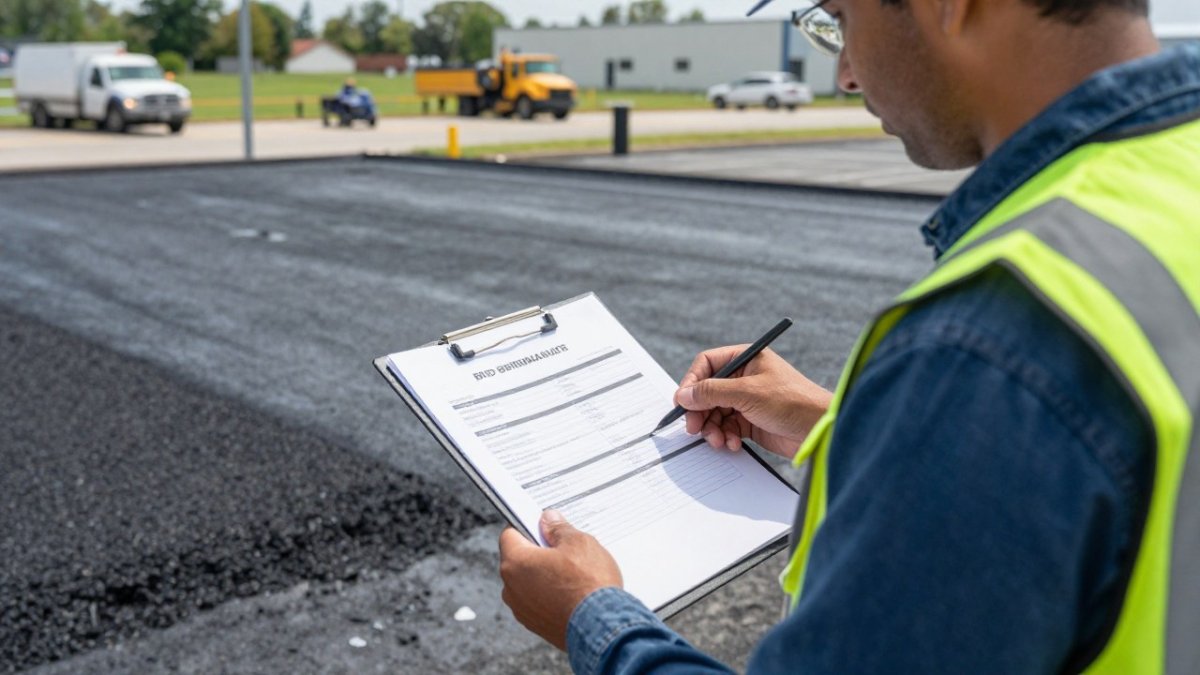
A scorecard is only useful if you fill it out the same way for every bidder and keep the evidence.
Watch out: a bidder who refuses to put technical application rates or weather limits in writing is telling you they either do not track those numbers or do not want to be held to them.
!A facility manager and a paving crew supervisor reviewing a printed bid proposal beside a parking lot with fresh chip seal aggregate
Chip Seal Project Timeline and Phasing for a Working Business
Chip seal work on an operating site needs careful sequencing.
Phasing protects operations. Splitting the lot into zones lets you keep access to some areas while others cure. Ask how the contractor will handle loading zones, customer parking, and emergency access.
Weather is the biggest variable. Chip seal depends on temperature and dry conditions, so the schedule should include contingency days.
Understanding Chip Seal Paving Cost Without Chasing the Lowest Bid
A cheap chip seal that bleeds, loses aggregate, or fails within a season can cost more to correct than a properly specified job the first time. But “don’t chase the lowest bid” is not a procurement strategy. You need a way to compare bids on a common basis and to weigh chip seal against alternatives over its service life.
Put every bid on a unit basis
Ask each bidder to price the work per square yard, broken into line items: surface preparation, crack sealing, binder, aggregate, rolling, traffic control, and cleanup. A bid that gives only a lump sum cannot be compared. When bids are on a unit basis, you can see whether a lower total reflects a smaller scope, a cheaper material, or a genuinely more efficient crew.
Common line items to require:
- Surface preparation (sweeping, patching, crack sealing), per square yard or per linear foot of crack
- Binder application, per square yard, with grade and rate stated
- Aggregate application, per square yard, with size and rate stated
- Traffic control and phasing, lump sum or per phase
- Mobilization and demobilization, lump sum
Compare chip seal against alternatives on lifecycle cost
Chip seal is a preventive treatment, not a reconstruction method. Its cost advantage shows up only when it is compared against alternatives over the same service window. A transparent comparison uses three inputs: initial cost per square yard, expected service life, and maintenance cost during that life.
- Slurry or micro-surfacing: higher initial cost than chip seal, similar or slightly longer service life, smoother finished surface, better suited to sites where loose aggregate is unacceptable.
- Asphalt overlay: substantially higher initial cost, longer service life, and appropriate when the pavement has structural distress that a surface treatment cannot correct.
- Reconstruction: highest initial cost, justified only when the base has failed.
The right comparison is cost per year of service, not cost per square yard. A treatment that costs more upfront but lasts twice as long can be the cheaper choice, and a treatment applied to pavement that is not a candidate for it is a waste at any price.
What drives the price of a chip seal
Pricing varies by site, but the main cost drivers are consistent:
- Area treated. Larger areas lower the per-square-yard cost because mobilization and equipment are spread over more work.
- Pavement condition. Heavy crack sealing or patching raises the prep cost and may change the treatment recommendation.
- Aggregate and binder selection. Premium aggregate and polymer-modified binders cost more but can extend service life on high-traffic commercial sites.
- Phasing and traffic control. A working business that needs the lot kept open requires more sequencing, more signage, and more crew time than an empty lot.
- Season and scheduling. Work compressed into a short weather window can carry a premium.
Because these variables differ from site to site, we do not publish a standard figure here. For current pricing or a quote, contact Global Paving directly.
Read the bid for what is missing
A bid that omits surface prep, traffic control, or cleanup is not truly lower, it is incomplete. Compare total scope, not the bottom line. If one bid is 20% below the others, the first question is what it left out, not whether it is a bargain.
Watch out: a bid that prices chip seal without first confirming the pavement is a candidate for it is pricing a treatment, not a solution. Confirm suitability before you compare numbers.
Booking Your Site Assessment With Global Paving
The most reliable way to compare contractors is to see how each one assesses your property.
If you are ready to take the next step, contact us to request a quote.
Frequently Asked Questions
What should I look for in a commercial chip seal contractor?
Look first for documented experience with chip seal on commercial or industrial sites similar to yours, not only residential or sealcoating work. Confirm the contractor carries active liability insurance and workers’ compensation, and ask for references from property managers with comparable traffic. Check that the crew performs the work itself rather than subcontracting the core operations, and ask how they handle traffic control and customer access during the job. A contractor that explains its surface preparation and quality-control steps clearly is usually easier to hold accountable later.
How do I know whether chip seal is suitable for my parking lot?
Chip seal works best on pavements that are structurally sound and show surface distress such as oxidation, raveling, or minor cracking. The FHWA chip seal checklist says to confirm the project is a good candidate and recommends limiting existing rutting to less than 3/8 inch. Pavements with heavy structural failure, extensive alligator cracking, or significant drainage problems generally need repair before any surface treatment. A qualified contractor should inspect the pavement and explain whether chip seal is appropriate or whether another treatment fits better.
How long does a commercial chip seal project take?
Duration depends on lot size, the number of phases, weather, and how much the site must stay open to customers and deliveries. Smaller lots can often be treated in one or two working days, while larger industrial yards may be phased across several weeks. Ask each bidder for a written schedule that shows curing time, traffic reopening, and the days your site will be partially closed. Contractors who commit to specific phasing and communicate changes in advance help limit disruption to operations.
What should a chip seal contractor include in a project proposal?
A complete proposal should define the scope by area, list the surface preparation steps, and specify the aggregate and binder being used. It should also cover traffic control, customer access plans, the project schedule, warranty terms, and what is excluded from the price. Ask whether repairs to cracks or failed areas are included and how unforeseen conditions will be priced. Comparing proposals line by line on these points makes the bids far easier to evaluate fairly.