Table of Contents
- Why Disruption Planning Matters for Commercial Asphalt Projects
- Phased Asphalt Paving: Breaking Your Project Into Manageable Sections
- Parking Lot Traffic Management During Construction
- Asphalt Curing Time Before Traffic: What You Need to Know
- Building an Asphalt Project Communication Plan
- Contractor Selection and Coordination
- Off-Peak and Overnight Scheduling Options
- Measuring Success: Disruption Metrics and Project KPIs
- Frequently Asked Questions
Last Updated: October 11, 2026
Why Disruption Planning Matters for Commercial Asphalt Projects
Managing asphalt projects with minimal disruption is essential for commercial properties. Downtime delays deliveries, drives customers elsewhere, and wastes employee time.
Properties that invest in disruption planning see faster completion, fewer operational headaches, and stronger contractor relationships through coordinated phasing, communication, and traffic management.
At Global Paving, we’ve managed thousands of projects throughout the Greater Phoenix area. The smoothest projects had the best plans, not the biggest budgets.
Phased Asphalt Paving: Breaking Your Project Into Manageable Sections
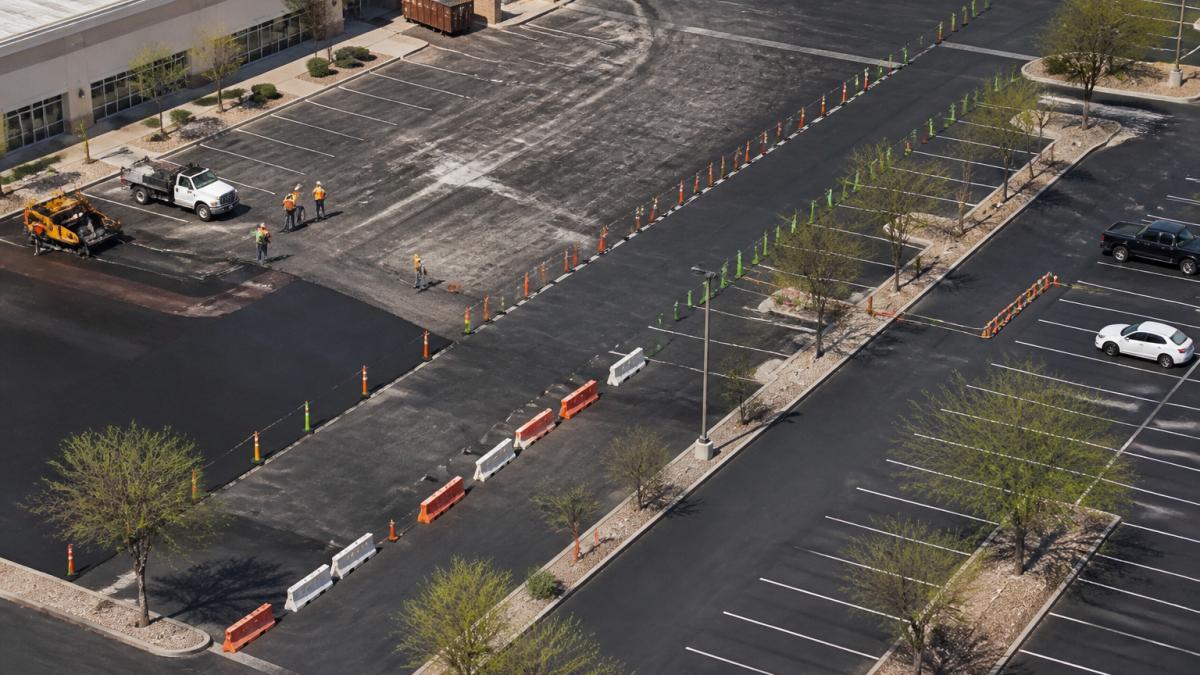
Phased asphalt paving divides your project into smaller, sequential sections so your property stays operational. Instead of closing your entire lot for two weeks, you work on one section at a time. Deliveries keep flowing, customers can park, and employees reach offices. The trade-off is a longer timeline, but operational continuity is worth it.
How to divide your parking lot or driveway
Map your property’s traffic flow: entry/exit points, high-use areas, and sections that can be isolated without blocking critical access.
Divide your lot into logical zones:
- High-traffic areas last (handle them when volume naturally drops)
- Delivery zones first or last, never middle (keeps supply chains intact)
- Accessible parking near entrances (preserve throughout project)
- Perimeter sections before central areas (easier to isolate)
Confirm with your contractor that each section can be completed before moving to the next. A five-section project takes 10 weeks instead of 2, but your business stays operational.
Sample timeline for a five-section project
A typical 20,000-square-foot parking lot phases like this:
- Week 1-2: Section 1 (northeast corner, low traffic), site prep, removal, new asphalt
- Week 3-4: Section 2 (northwest perimeter), same process
- Week 5-6: Section 3 (south delivery zone), coordinate timing around delivery schedules
- Week 7-8: Section 4 (east side, medium traffic), adjust schedule if weather delays occur
- Week 9-10: Section 5 (central lot, highest traffic), complete during slowest business period
Each section needs 48-72 hours of curing time before full traffic returns. Communicate these windows to your team.
Parking Lot Traffic Management During Construction
Parking lot traffic management during construction requires clear routing, visible signage, advance coordination, and documented compliance with accessibility and emergency response standards to prevent confusion, illegal parking, emergency delays, and liability.
Maintaining access for deliveries and emergency vehicles
Coordinate with your contractor to establish a dedicated delivery and emergency route that bypasses active work zones, marked clearly with signs and cones 100 feet before the work area. Confirm delivery schedules two weeks ahead, notify drivers of the temporary route, post signage at lot entrances, and assign one staff member as the point of contact.
Contact your local fire department and emergency services at least three weeks before work begins with a site map, confirmation the route stays clear, your project manager’s contact info, and notification of any changes. Request written approval and keep documentation on file, many jurisdictions require this before permits are issued.
Pedestrian and accessible parking considerations
Accessible parking and pedestrian safety are legal ADA requirements. Violations can result in DOJ complaints, lawsuits, and fines.
Accessible parking requirements:
- Keep accessible spaces open throughout the project.
- If work affects an accessible space, relocate it to an equally convenient location with the same distance to the nearest entrance, level surface, clear signage, and van-accessible dimensions (8 feet minimum width plus 5-foot access aisle).
- Post signage at the original location and notify regular users at least two weeks in advance.
- Verify the temporary space is not in a work zone or delivery route.
Create safe pedestrian paths around work zones using barriers or temporary paving. Mark routes with bright tape at eye level, directional signage every 50 feet, adequate lighting, and a minimum 4-foot-wide clear path. For high-traffic areas or transit stops, use temporary walkways to keep people clear of work and equipment.
Compliance documentation:
Keep records of:
- Dates accessible parking was relocated and signage posted
- Photos of accessible parking and pedestrian routes during the project
- Confirmation that emergency access was maintained
- Any complaints or access issues and how they were resolved
This documentation protects you if questions arise later and demonstrates good-faith compliance with accessibility requirements.
Asphalt Curing Time Before Traffic: What You Need to Know
Asphalt curing time before traffic determines when you can reopen each section. Rushing causes rutting, cracking, bleeding, and premature failure. Curing depends on weather, temperature, humidity, and asphalt mix design, so plan contingencies for common delays.
Standard curing windows and temperature factors
New asphalt typically needs 48-72 hours to cure before normal traffic returns. Temperature is the primary driver: warm weather (75°F+) allows 48-hour curing; moderate weather (55-75°F) requires 72-96 hours; cool weather (below 55°F) requires 5-7 days; cold weather (below 40°F) prevents proper curing and most contractors won’t pave.
High humidity slows curing. Rain during curing is the biggest disruptor, wet asphalt doesn’t set properly and traps moisture, causing future cracking and potholes. Add 24-48 hours to your timeline for each rain event. Check the forecast before scheduling; plan projects during dry seasons (late spring through early fall) when possible. If paving during unpredictable weather, build in 5-7 buffer days.
Reopening criteria and inspection checkpoints
Use these inspection checkpoints before allowing traffic: Visual inspection (uniformly dark surface, no tire marks, no bleeding or raveling); Touch test (firm surface, no impression from thumb pressure); Temperature check (surface temperature matches ambient air, verified with infrared thermometer); Contractor sign-off (written confirmation that the section meets reopening criteria, with photo or video documentation).
Contingency scenarios and decision trees
Common scenarios: Rain during curing, add 48 hours and notify stakeholders same day. Temperature drops, extend timeline 2-3 days and monitor daily. Pressure to reopen early, do not yield; have contractor confirm early reopening violates standards and voids warranty. Surface still tacky, contact contractor immediately; may require tack coat, re-compaction, or re-work (adds 2-5 days). Hidden damage, stop traffic, document with photos, contact contractor for warranty repair (adds 3-7 days).
Warranty and post-curing monitoring
Your contract should specify:
- Curing timeline and reopening criteria
- Contractor responsibility if curing issues arise
- Your right to withhold final payment if reopening criteria are not met
After reopening, monitor the new asphalt for the first 30 days:
- Watch for rutting (tire tracks that don’t bounce back)
- Watch for bleeding (sticky spots)
- Watch for cracking or raveling
- Document any issues with photos and dates
If problems appear within the warranty period, contact your contractor for repairs. Most reputable contractors will address defects quickly to protect their reputation.
Building an Asphalt Project Communication Plan
Communication prevents chaos. A clear communication plan keeps your team, customers, and contractors aligned throughout the project.
Notification timeline and channels
Start communicating 4 weeks before work begins:
- Week 4: Email announcement to customers, employees, and regular delivery partners. Explain what’s happening, why, and the phasing schedule.
- Week 2: Detailed notice with maps showing work zones, alternate parking, and access routes. Post signage in the lot.
- Week 1: Final reminder with exact start date and first-week details.
- During project: Weekly updates if delays occur. Immediate notification if schedule changes.
- After project: Thank-you message acknowledging inconvenience.
Use multiple channels: email, phone calls to key contacts, physical signage, your website, and social media. Redundancy ensures the message gets through.
Handling schedule changes and weather delays
Weather delays happen. Communicate them immediately. A customer who learns about a delay from a closed gate is frustrated. A customer who receives an email explaining the delay accepts it.
Establish a protocol with your contractor:
- Contractor notifies you of delays by 5 p.m. the day before
- You notify customers, employees, and delivery partners by 7 p.m.
- Post updated signage at lot entrances
- Update your website homepage with new timeline
This prevents surprise closures and maintains trust.
Contractor Selection and Coordination
The right contractor makes managing asphalt projects with minimal disruption possible. The wrong one guarantees problems.
Questions to ask before hiring
Ask these questions during contractor interviews:
- How do you handle phasing on projects this size?
- What’s your process for maintaining access during work?
- How do you communicate delays to property managers?
- Can you provide references from similar commercial projects?
- What’s your contingency plan if weather delays work?
- Do you have equipment on-site for emergency access if needed?
- What happens if a section isn’t cured on schedule?
Listen for specific answers. Vague responses are red flags. A contractor who’s done this before will have detailed answers.
Establishing accountability for schedule adherence
Put your agreement in writing. Your contract should include:
- Exact dates for each phase start and completion
- Penalties for missed deadlines (reduced payment or project extension)
- Weather delay provisions (how many days of rain pause the clock)
- Communication requirements (daily updates, weekly reports)
- Reopening criteria and inspection process
- Warranty terms for curing and traffic readiness
A written agreement protects both you and the contractor. It removes ambiguity and sets clear expectations.
Off-Peak and Overnight Scheduling Options
Some projects work better during off-peak hours or overnight. This approach minimizes disruption to daily operations but requires careful planning and higher contractor costs.
Off-peak scheduling works best for high-traffic commercial areas. Schedule paving for weekends or after-hours when customer volume is lowest. Overnight work allows completion during closed hours, reopening fresh the next morning.
The trade-off: overnight and weekend work costs more. Contractors charge premium rates for non-standard hours. Weigh the operational benefit against the cost increase.
Coordinate closely with your contractor on overnight work. Lighting, noise, and safety become bigger concerns. Notify neighbors if your property is near residential areas.
Measuring Success: Disruption Metrics and Project KPIs
Track your project’s impact on operations. Measurement helps you evaluate contractor performance and plan future projects better.
Key metrics to monitor:
- Downtime hours: Total hours each section was closed
- Access incidents: Complaints about blocked deliveries or parking
- Schedule adherence: Days ahead or behind the original timeline
- Customer satisfaction: Feedback from customers about the experience
- Asphalt quality: Post-project inspections for proper curing and surface quality
- Cost per day: Total project cost divided by days elapsed
Compare these metrics to your pre-project baseline and to industry standards. If your contractor delivered the project on schedule with minimal access issues and high-quality results, they’ve earned your repeat business.
Managing asphalt projects with minimal disruption requires planning, communication, and the right contractor. The strategies in this guide work because they prioritize your operations while ensuring quality paving work. Global Paving brings over two decades of experience coordinating phased projects, maintaining access, and keeping commercial properties operational throughout construction.
Frequently Asked Questions
How can a business stay open during asphalt paving?
Phased paving allows you to keep parts of your parking lot and access routes open while work happens on other sections. Coordinate with your contractor to maintain delivery access, employee parking, and customer entry points throughout the project. Overnight or off-peak scheduling also keeps daytime operations unaffected. Clear signage and advance tenant or customer communication ensure people know where to go and what to expect.
How long does asphalt need to cool before traffic can use it?
Fresh asphalt typically requires 24-48 hours before regular traffic can resume, depending on temperature and weather conditions. Hot pavement needs time to cool and cure fully, driving on it too early causes rutting and surface damage. Your contractor should specify exact reopening criteria based on site conditions. Cooler weather extends curing time; hot conditions may speed it slightly. Always follow your contractor’s timeline rather than estimating.
How far in advance should tenants and customers be notified about paving work?
Notify stakeholders at least 2-3 weeks before work begins, with a second reminder 1 week out. Include specific dates, phased work areas, access routes, and expected noise or temporary closures. For large commercial properties or HOAs, email, signage, and direct calls work best. Provide a contact number for questions and updates on weather delays. Clear, early communication prevents complaints and keeps operations running smoothly.
What should a paving project disruption plan include?
A solid disruption plan covers phased work sections, traffic flow routes, delivery and emergency access, curing timelines, communication schedules, and contingency steps for weather delays. Identify which areas close when, where temporary parking or pedestrian access routes go, and how long each phase takes. Include roles and responsibilities for your team and the contractor, plus measurable KPIs like uptime percentage or on-time completion. Document everything in writing before work starts.