Last Updated: November 23, 2026
Quick Summary
Commercial chip seal project cost depends mainly on surface condition, lot area and layout, materials, labor and equipment, traffic control, scheduling, and life-cycle value. Chip seal is usually cheaper than mill-and-overlay, but bids must cover the same scope to compare fairly.
- Federal Highway Administration reports about $25,000 per lane-mile for chip seal versus $100,000 for mill-and-overlay.
- Badly cracked or failing pavement needs more prep work before sealing, which raises cost.
- Compare bids only when each includes prep, materials, traffic control, cleanup, striping, and mobilization.
- Ask for surface repair scope in writing, since a low bid may hide prep work billed later.
- Check pavement-surface temperature on site, since it can differ from the forecast air temperature.
Table of Contents
- What Drives the Cost of a Commercial Chip Seal Project?
- How Chip Seal Cost per Square Foot Is Calculated
- Pavement Condition and Site Preparation Requirements
- Weather Requirements: Temperature, Humidity, Rain and Wind
- How Curing Time Affects Scheduling and Traffic Reopening
- Comparing Chip Seal Costs with Mill-and-Overlay Options
- Planning Your Commercial Chip Seal Project With Global Paving
- Frequently Asked Questions
What Drives the Cost of a Commercial Chip Seal Project?
Chip seal is usually the lower-cost preservation option for a commercial lot, but the final price depends on several variables. The Federal Highway Administration reports an average chip seal cost of $25,000 per lane-mile, compared with $100,000 per lane-mile for a traditional 1.5-inch mill-and-overlay project (Federal Highway Administration, Innovator comparison of treatment costs).
Here are the main cost drivers we see on commercial jobs:
- Surface condition: Badly cracked or failing pavement needs more prep work before sealing.
- Area and layout: Large open lots cost less per square foot than small sites broken up by islands and curbs.
- Materials: Binder type, aggregate choice, and application rate all change the total.
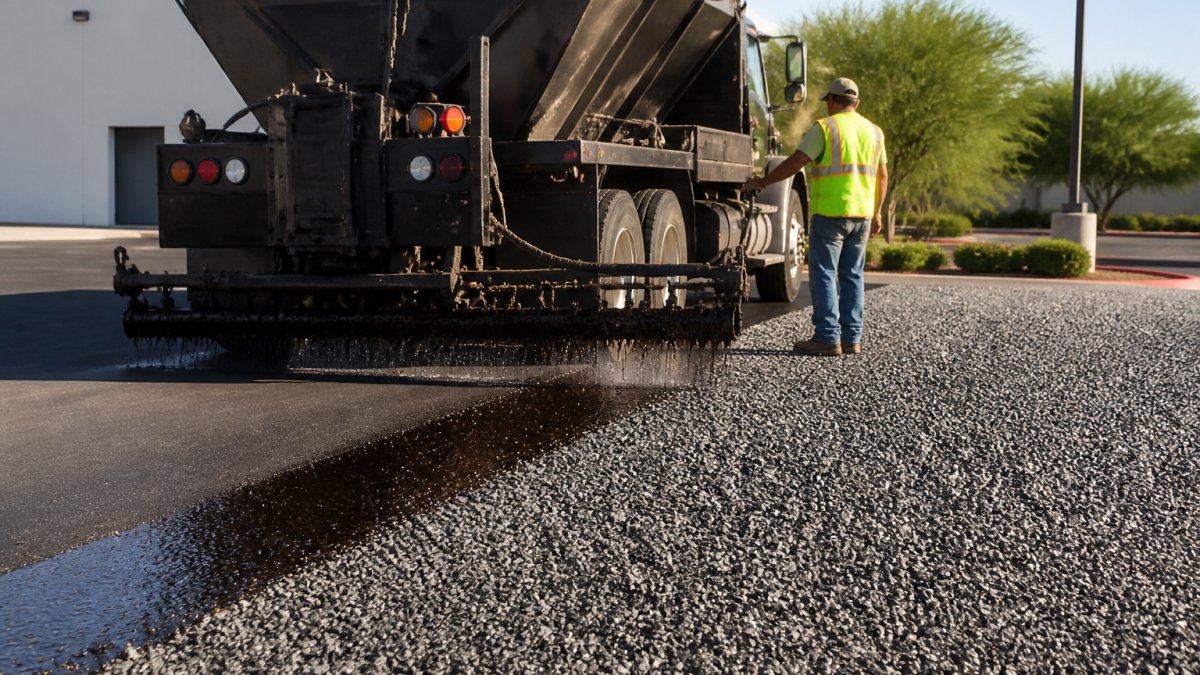
- Labor and equipment: Crew size, sweepers, distributors, and rollers add to the bill.
Watch out: A low initial bid can hide prep work that gets billed later. Ask for the scope of surface repairs in writing.
Pricing depends on quantity, dates, and site conditions. For a current quote on your property, contact Global Paving directly.
How Chip Seal Cost per Square Foot Is Calculated
Chip seal cost per square foot is the total project price divided by the treated area. This number helps property managers compare bids, but it only works when the bids cover the same scope.
Before comparing bids, check that each one includes:
- Surface preparation, including crack sealing and patching
- Binder and aggregate quantities
- Traffic control and cleanup
- Striping, if your plan requires it
- Mobilization and demobilization
A bid that looks low per square foot may leave out striping or repairs. Asking each contractor to price the same scope keeps the comparison fair.
Pavement Condition and Site Preparation Requirements
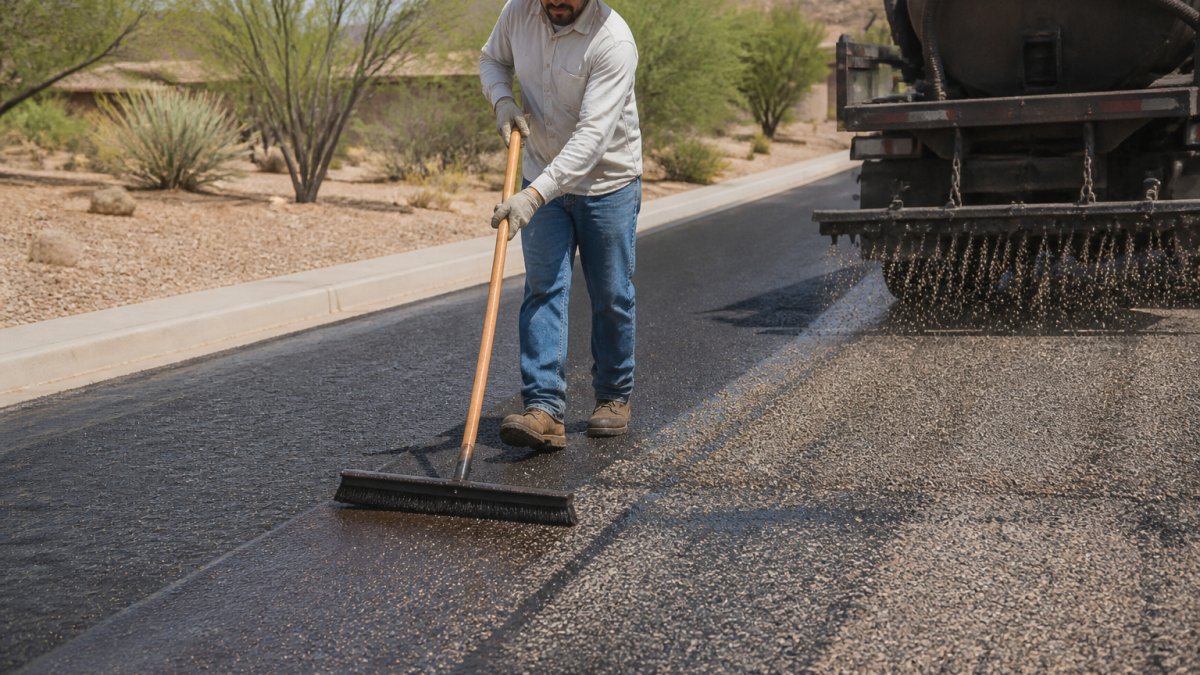
Site preparation is one of the biggest factors in a chip seal project’s success. A chip seal bonds to the existing surface, so the pavement underneath has to be sound. Weak, oily, or crumbling areas will not hold the seal.
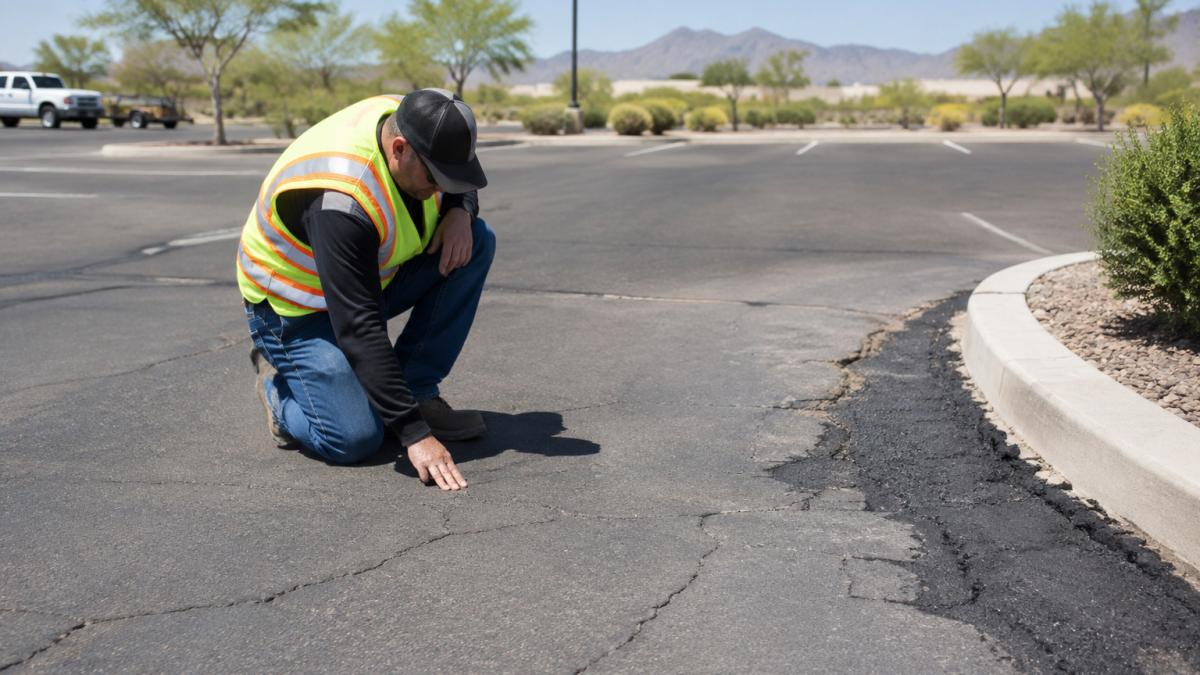
Expect these steps on most commercial sites:
- Inspect the surface for cracks, potholes, and failing edges.
- Repair damaged areas before sealing.
- Clean the surface to remove dirt, debris, and loose material.
- Protect curbs, drains, and nearby structures.
- Plan traffic control for the work area.
Oregon’s chip seal design and specifications report explains that a rational design method supports better chip seal performance (Oregon Department of Transportation chip seal design and specifications report).
Weather Requirements: Temperature, Humidity, Rain and Wind
Weather is the single most common reason a commercial chip seal job gets postponed, and it is the factor most often handled loosely in bids. Temperature, humidity, rain, and wind all interact, so a crew that checks only the air temperature on the morning of the job is not really checking the weather.
Air temperature versus pavement-surface temperature
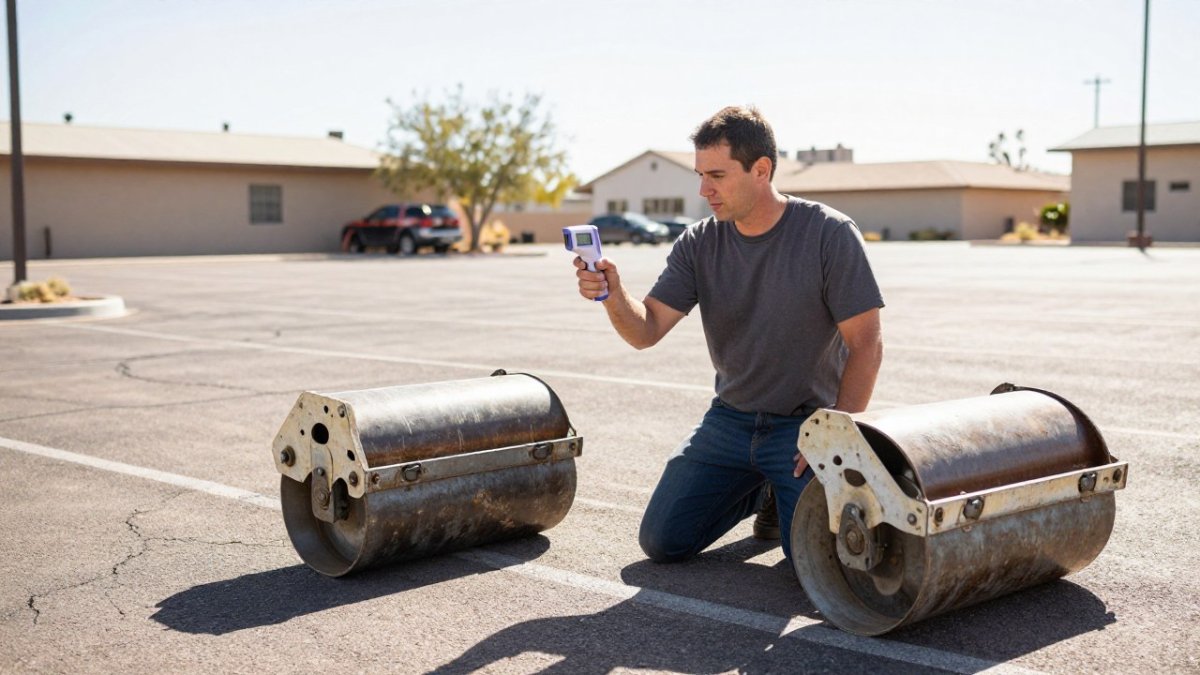
Air temperature is what the forecast reports; pavement-surface temperature is what the emulsion actually reacts to. On a sunny afternoon, an asphalt surface can run well above the reported air temperature, and on a clear night it can run below it.
Measure pavement temperature with an infrared thermometer held close to the surface, and confirm with a probe or contact thermometer in at least three spots across the lot. Recheck readings at midday and again before the distributor starts, because surface temperature can swing several degrees in an hour. Readings taken in the shade of a building or under a parked trailer are not representative of the treated area.
Minimum temperature thresholds by binder
The threshold depends on the binder system, not on a single company-wide rule. As a general guide:
- Emulsified asphalt: the product data sheet sets the minimum pavement temperature, which should be confirmed before application.
- Polymer-modified emulsions: temperature limits should be taken from the product data sheet, since curing still depends on warmth and dryness.
- Hot-applied asphalt cement: requires warmer pavement and air than emulsion systems, so the product data sheet and project conditions should be reviewed.
Watch out: A bid that promises a fixed application date without naming the binder and its minimum pavement temperature is a bid that has not priced weather risk. Ask for the threshold in writing.
Humidity, wind, and evaporation in combination
Humidity and wind work against each other, and the combination matters more than either alone. High humidity slows the evaporation that breaks an emulsion, which can stretch curing time and delay reopening. Wind accelerates evaporation and can dry the emulsion before the chips have seated, and strong gusts blow loose aggregate off the mat. A warm, windy, low-humidity day can cure fast; a cool, humid, still day can leave the surface tacky for hours.
Rain and the curing window
Rain is not just a problem on application day. Rain during the curing window can wash emulsion off the aggregate and leave a patchy, failed seal. Check the forecast for the full curing period, not just the morning of the work, and treat any meaningful chance of rain within that window as a reason to reschedule. Overnight rain after a daytime application is a common cause of callbacks.
A go/no-go weather checklist for commercial crews
Use this as a field decision process rather than a set of isolated thresholds:
- Pavement temperature measured on site meets the binder’s minimum and is trending upward
- Air temperature is above the product’s stated minimum and not forecast to drop sharply
- Forecast shows no rain through the full curing window, including overnight
- Humidity and wind together are not expected to stall or accelerate cure beyond the plan
- A backup date and a traffic-control plan are in place if conditions change
If any box is unchecked, the crew should not start. The cost of a reschedule is almost always lower than the cost of a failed seal.
The article’s weather guidance comes down to a few factors a crew should check before starting work.
| Factor | What to check | Why it matters |
|---|---|---|
| Pavement-surface temperature | Measure on the surface being sealed, not inferred from air temperature | Emulsion reacts to surface temperature, which can differ from air temperature |
| Binder type | Confirm the minimum pavement temperature in the product data sheet | Each binder system has its own threshold |
| Humidity and wind | Assess together, not separately | High humidity slows curing while wind speeds evaporation and can blow aggregate off |
| Rain in curing window | Check the forecast for the full curing period, including overnight | Rain can wash emulsion off aggregate and cause a patchy failed seal |
| Go/no-go decision | Confirm all checklist items before starting | If any item is unchecked, the crew should not start |
How Curing Time Affects Scheduling and Traffic Reopening
Curing is the period the emulsion needs to break, set, and bond before traffic runs over it. For a retail-focused look at scheduling around curing and reopening, see the retail maintenance guide. On a commercial site, curing time is not just a technical detail, it drives crew scheduling, tenant communication, and whether the lot can reopen for the Monday delivery window.
What actually controls curing time
Curing depends on the binder, the application rate, the aggregate, and the weather during the cure. Warm, dry, breezy conditions generally speed the break; cool, humid, still conditions slow it. Polymer-modified emulsions often cure on a different curve than unmodified ones, and a heavier application rate holds traffic longer than a light one. Because of that, the reopening time should be set by the product data sheet and the contractor’s field judgment, not by a fixed number copied from a previous job.
Commercial scheduling constraints competitors don’t address
A commercial chip seal is a multi-day operation even when the seal itself goes down in one pass. The schedule has to account for:
- Mobilization and surface prep: sweeping, crack sealing, and patching usually happen on a separate day from the seal.
- Distributor and roller availability: the chip spreader and rollers are often shared across jobs, so a weather delay cascades.
- Traffic control: lane closures, flaggers, and signage have to be re-booked if the date moves.
- Tenant and delivery notice: retail, medical, and logistics tenants need lead time to reroute trucks and customers.
- Sweeping of loose chips: this happens after cure and is a second traffic-control event.
A common pattern is to schedule the seal early in a dry window and hold the next available dry day as a contingency. If you are ready to hire, our guide on choosing a commercial chip seal contractor explains what to look for. Building that buffer into the contract is cheaper than scrambling after a rain-out.
Reopening guidance by traffic type
Reopening and sweeping sequence should be specified by the contractor in the scope, not left for the property manager to determine.
Watch out: A schedule that promises reopening the next morning without accounting for overnight lows or humidity is a schedule that has not priced the cure. Ask what happens if the cure runs long.
Contingency planning for weather delays
Commercial projects should carry an explicit weather contingency: a backup date, a defined decision point (for example, a pavement-temperature check the afternoon before), and a communication plan for tenants. The cost of a one-day slip is usually far below the cost of a failed seal that has to be removed and replaced.
Comparing Chip Seal Costs with Mill-and-Overlay Options
Chip seal and mill-and-overlay solve different problems. Chip seal is a preservation treatment that protects a pavement that is still in fair condition. Mill-and-overlay removes the top layer of asphalt and replaces it, which suits a more badly worn surface.
The cost gap is large. The Federal Highway Administration figures show chip seal at $25,000 per lane-mile versus $100,000 per lane-mile for a 1.5-inch mill-and-overlay (Federal Highway Administration, Innovator). A 2024 study also reports that a chip seal pavement structure can be up to 40% less expensive than an optimal hot-mix asphalt structure (Cost Effectiveness of Chip Seal and Hot Mix Asphalt Pavements, 2024).
Savings from chip seal depend on whether the pavement is a good fit for the treatment. You can learn more about our chip seal service.
Planning Your Commercial Chip Seal Project With Global Paving
A good commercial chip seal project starts with an honest look at the pavement, the weather window, and the budget. For a fuller picture of commercial costs and scope, read our commercial chip seal project guide, or use our 2026 cost estimating guide to work through cost per square foot.
Our team can review your site, explain which cost factors apply, and give you a written scope you can compare against other bids. Contact Global Paving for a quote.
Frequently Asked Questions
What temperature is too cold for chip seal?
Chip seal should generally not be applied when the air or pavement is too cold for the emulsion to break and cure properly. Thresholds depend on the binder and chip-seal system, so crews typically check both air temperature and pavement-surface temperature, and they watch whether temperatures are rising or falling through the application window. Because forecast conditions can change, a contractor should confirm the work window before mobilizing equipment and crews, and should plan contingency days for schedule slips caused by weather.
How long does chip seal take to cure before traffic can return?
Curing time varies with temperature, humidity, wind, binder type and aggregate. Warm, dry, breezy conditions speed evaporation and early bonding, while cool or humid conditions slow it down. Many projects reopen to traffic after the emulsion has broken and the surface has set enough that loose chips no longer shift under tires, but reopening timelines should be confirmed by the contractor for each project. Traffic control and road closure plans should allow for this period so business operations are disrupted as little as possible.
How is chip seal cost per square foot calculated?
Per-square-foot pricing is driven by the area treated, the chip-seal system specified, the quantities of asphalt emulsion and aggregate applied per unit area, and the surface preparation required. Pricing depends on quantity, schedule and site conditions, so the most accurate figure comes from a site-specific quote. For current pricing and a project estimate, contact Global Paving through its website.