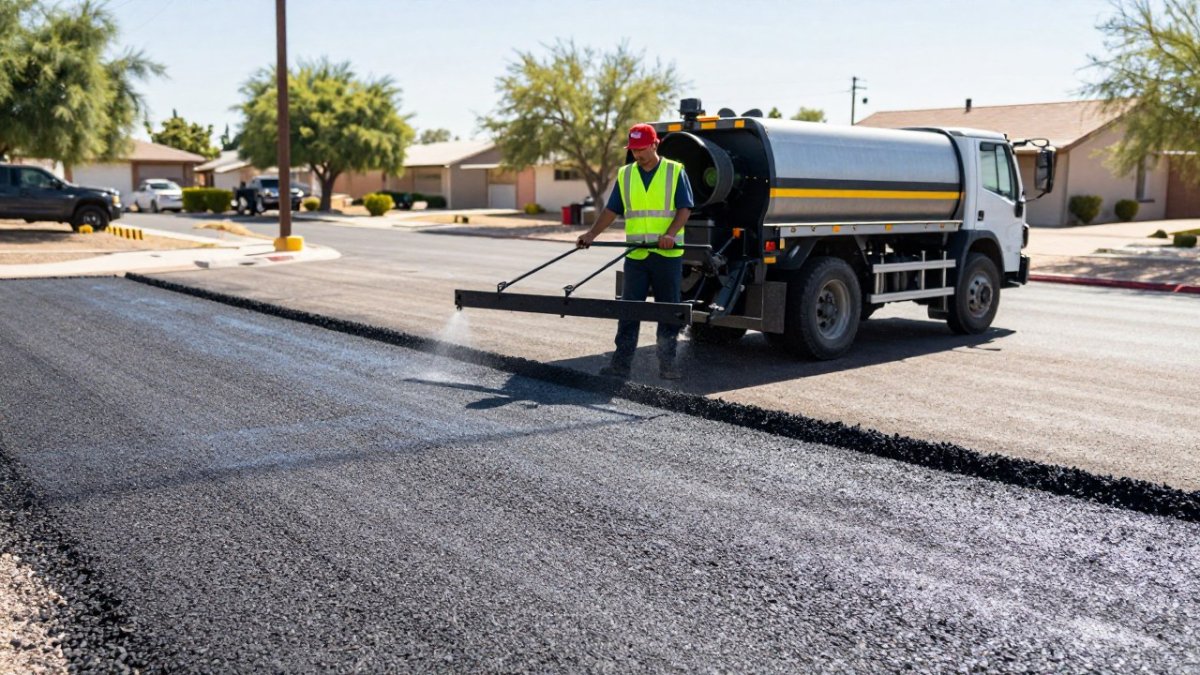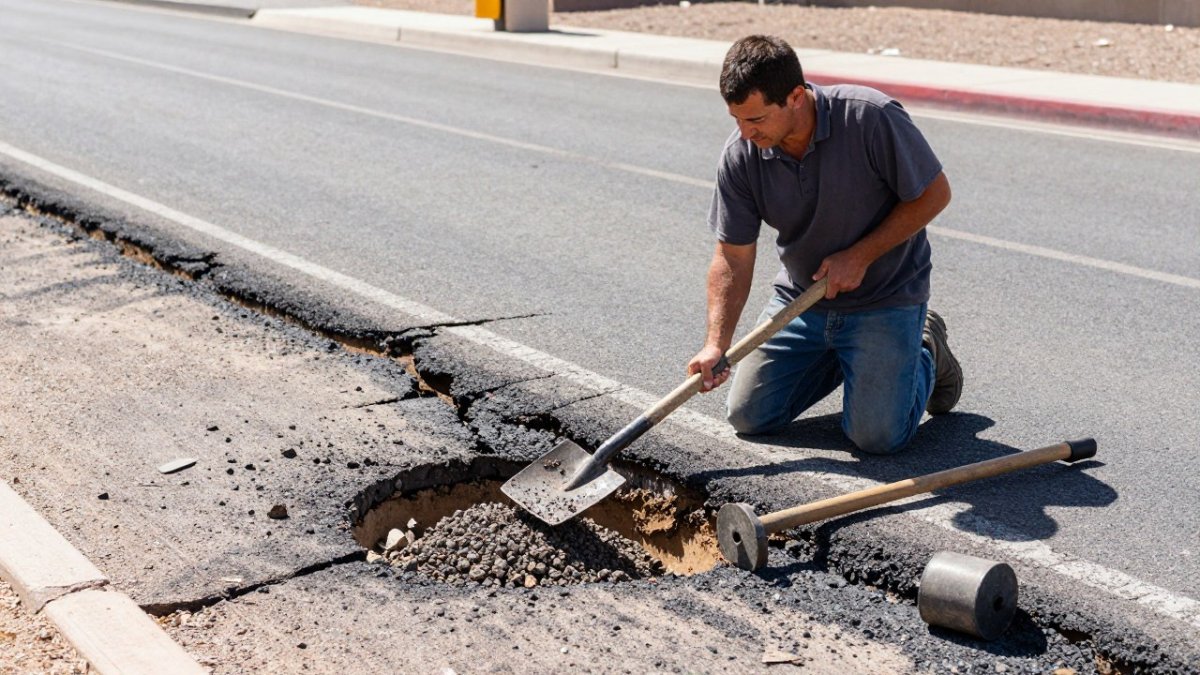
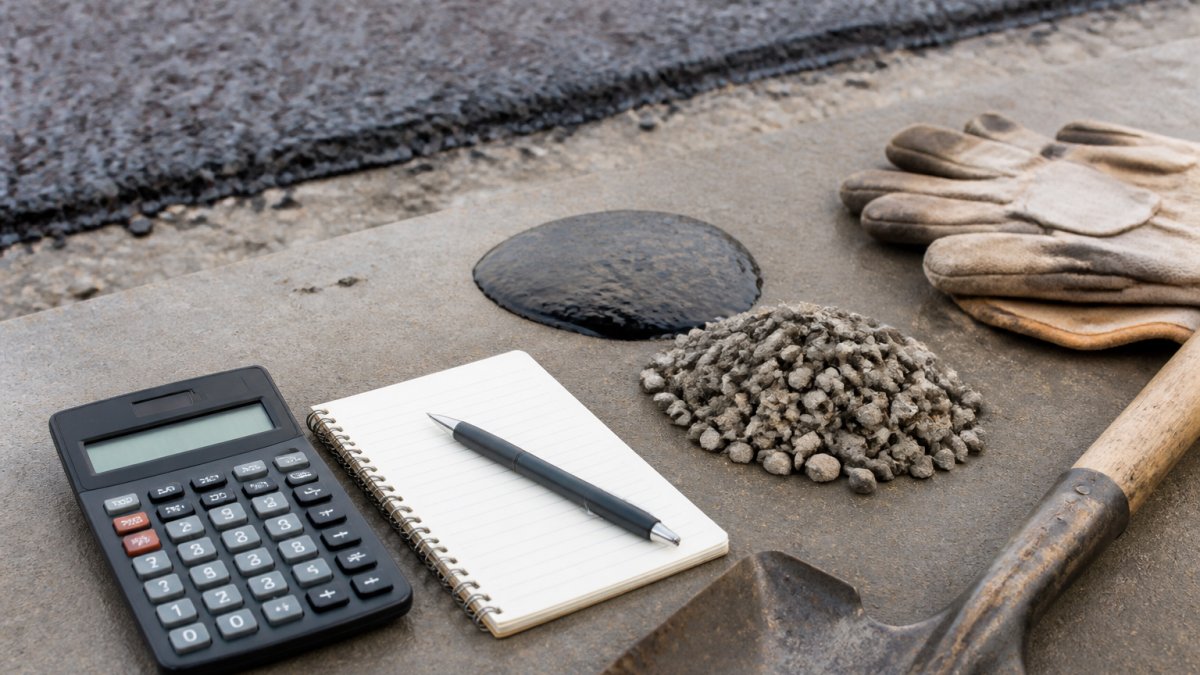
Table of Contents
- What Drives Chip Seal Cost in Arizona
- Chip Seal Cost Per Square Foot: What Changes the Number
- Chip Seal vs Asphalt Cost: Where the Money Actually Goes
- The Chip Seal Installation Process, Step by Step
- Chip Seal Driveway Lifespan and Lifecycle Cost
- How to Compare Chip Seal Quotes
- Conclusion
- Frequently Asked Questions
Last Updated: October 13, 2026
What Drives Chip Seal Cost in Arizona
Chip seal cost in Arizona depends on four main variables: the size of the surface, the condition it is in, the aggregate and emulsion you choose, and how far the crew and materials have to travel. Get those four right and the price becomes predictable.
Chip seal is a surface treatment that sprays asphalt emulsion onto a prepared road or driveway, then covers it with crushed stone chips that are rolled into the binder. It is not a structural fix.
This guide from Global Paving covers what actually moves the number, how chip seal stacks up against asphalt and concrete, and how to read a quote without getting taken. We have spent over two decades working on commercial, industrial, and HOA properties across the Greater Phoenix area.
Chip seal rarely fails because of the material. It fails because the base underneath was not ready, or because someone priced the job without accounting for prep, traffic control, and curing time.
Chip Seal Cost Per Square Foot: What Changes the Number
Most chip seal pricing is quoted per square foot, with larger road and rural projects often priced per mile instead. The per-square-foot figure is not a fixed rate. It moves with five factors:
- Surface area. Bigger jobs spread fixed costs like mobilization and traffic control across more square footage, which lowers the unit price.
- Surface condition. Cracks, potholes, and failed patches need repair before any chip seal goes down.
- Aggregate choice. Local crushed rock costs less than specialty or imported stone, and the size you pick changes the spread rate.
- Emulsion type and application rate. A heavier binder application costs more per square yard but can extend service life.
- Access and logistics. A tight residential driveway with no staging room costs more to seal than an open industrial lot.
Typical Price Ranges by Project Type
| Project Type | Typical Unit Price | Typical Total |
|---|---|---|
| Residential driveway (single-coat, 1,000-2,000 sq ft) | $0.20-$0.40 per sq ft | $200-$800 |
| Residential driveway (double-coat, 1,000-2,000 sq ft) | $0.35-$0.60 per sq ft | $350-$1,200 |
| Long rural driveway (5,000-20,000 sq ft) | $0.15-$0.35 per sq ft | $750-$7,000 |
| Private road or HOA lane (per mile, single-coat) | $15,000-$35,000 per mile | , |
| Private road or HOA lane (per mile, double-coat) | $25,000-$50,000 per mile | , |
| Commercial or industrial lot | $0.18-$0.45 per sq ft | Varies with size |
A common pattern is that the per-square-foot price falls as the job gets larger, because mobilization, traffic control, and equipment setup are fixed costs.
What a Quote Should Break Down
A transparent bid separates the job into line items so you can see where the money goes. Ask for these categories:
- Site preparation and repair, crack filling, patching, pothole repair, grading, and drainage correction. This is often 15-30% of the total on a distressed surface.
- Materials, asphalt emulsion (binder) and aggregate chips. Aggregate type and emulsion grade drive this line.
- Labor, crew time for spraying, spreading, rolling, and sweeping.
- Mobilization, getting the distributor truck, chip spreader, and rollers to your site. This is a fixed cost that hurts small jobs most.
- Traffic control, flaggers, cones, and signage for roads and shared driveways.
- Cleanup and sweeping, removing loose chips after cure.
- Taxes and permits, sales tax on materials and any local right-of-way permit fees.
Worked Example: A 1,500-Square-Foot Driveway
Assume a sound but weathered asphalt driveway with a few cracks, single-coat chip seal, local aggregate, easy access:
| Line Item | Estimate |
|---|---|
| Crack filling and prep | $150-$300 |
| Emulsion (binder) | $120-$200 |
| Aggregate chips | $80-$150 |
| Labor | $100-$180 |
| Mobilization | $100-$250 |
| Sweeping and cleanup | $50-$100 |
| Total | $600-$1,180 |
That works out to roughly $0.40-$0.79 per square foot for a small job, which is why small driveways carry a higher unit price than long rural roads. A 10,000-square-foot rural driveway with the same scope might land near $0.25 per square foot because the fixed costs spread further.
What Pushes the Price Up or Down
- Distance from the nearest aggregate source. Hauling crushed rock long distances adds to the material line.
- Terrain and access. Steep grades, tight turns, and soft shoulders slow the crew and require more equipment time.
- Soil and drainage. Poor drainage means extra grading and possibly a base repair before sealing.
- Project size. Larger jobs get a lower unit price.
- Season. Peak warm-weather months can carry a premium; off-season scheduling sometimes saves money.
- Number of coats. A double-coat roughly doubles the material and labor lines but can extend service life.
The honest answer is that no responsible contractor quotes a per-square-foot rate over the phone. Site conditions decide the number, and anyone who skips that step is guessing.
Arizona Department of Transportation pavement preservation guidance
Chip Seal vs Asphalt Cost: Where the Money Actually Goes
Chip seal can be a cost-effective alternative to a full asphalt overlay or concrete. The nuance is what you are buying.
| Option | Relative Upfront Cost | Typical Service Life | Best For |
|---|---|---|---|
| Chip seal | Lowest | 5-7 years | Preserving sound pavement, rural roads, long driveways |
| Asphalt overlay | Moderate | 15-20 years | Pavement with structural damage |
| Full-depth asphalt | Higher | 20+ years | New construction, failed subgrade |
| Concrete | Highest | 30+ years | Heavy static loads, low-maintenance goals |
A chip seal is a maintenance decision, not a replacement decision. If your pavement still has good bones, sealing it is the cheapest way to buy yourself another several years. If the base has failed, chip seal will simply crack along with it, and you will have paid for a cosmetic fix.
That is the part most guides skip. The cheapest option is only cheap if it matches the problem.
The Chip Seal Installation Process, Step by Step
A standard chip seal job runs through six stages, and skipping any one of them shortens the life of the surface.
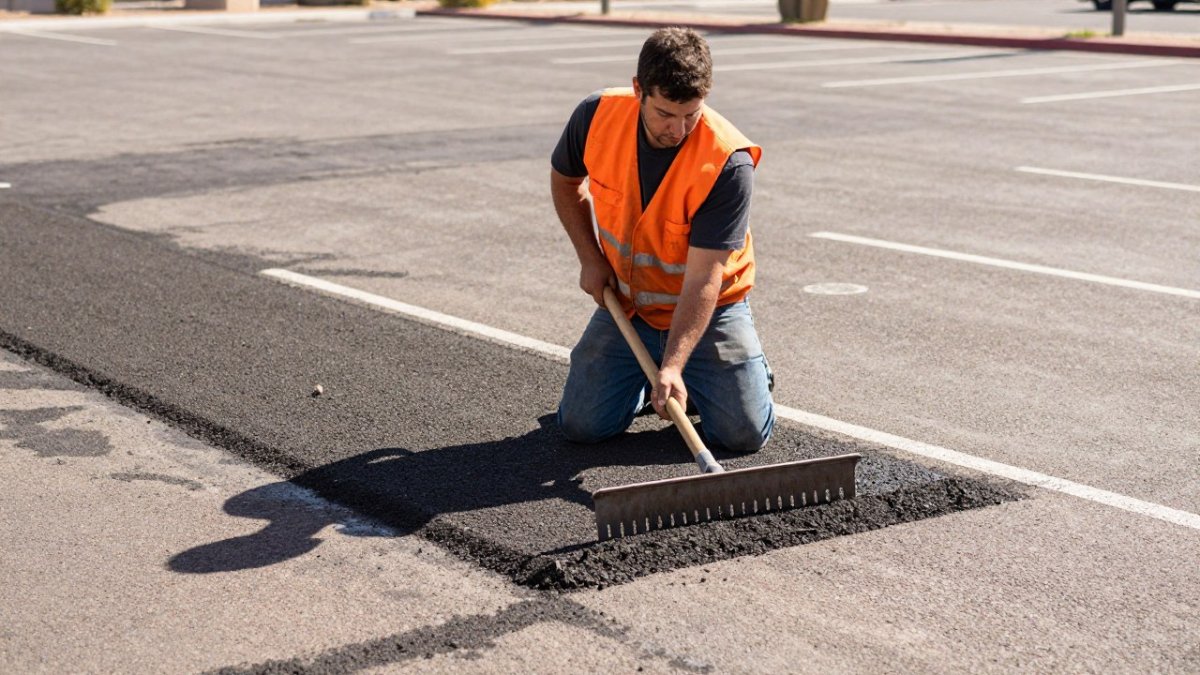
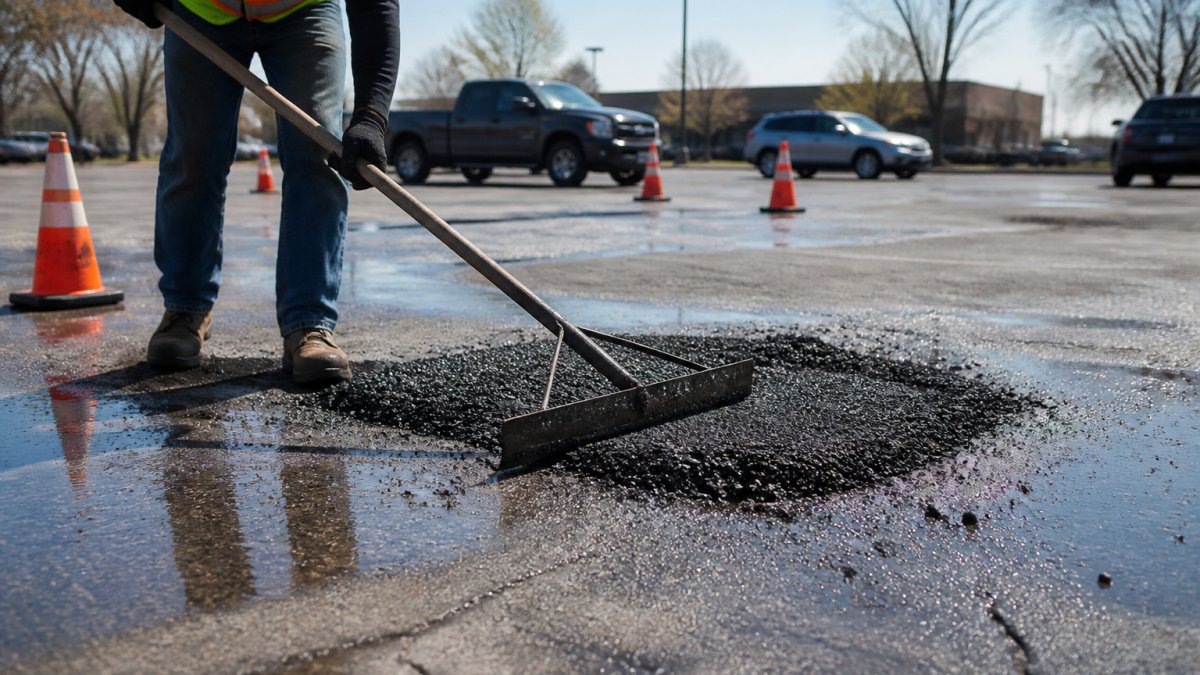
- Inspect and repair. Crews fill cracks, patch potholes, and address drainage issues before anything else happens.
- Clean the surface. Loose gravel, dirt, and vegetation get swept or blown off so the emulsion can bond.
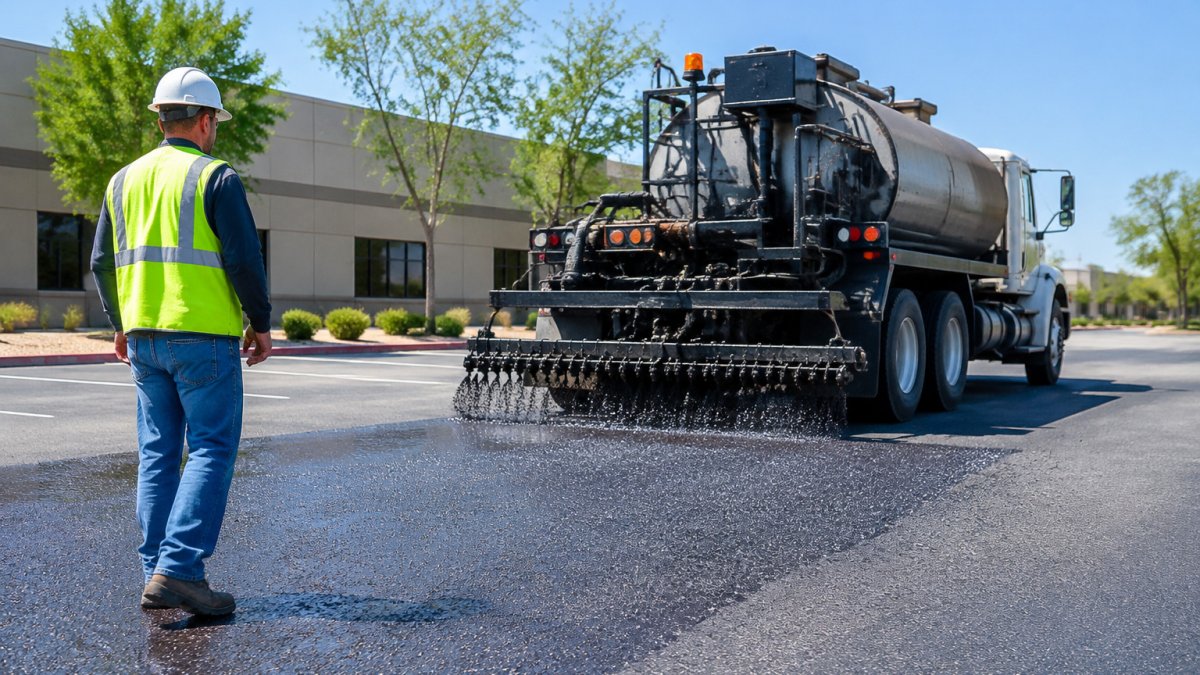
- Apply the asphalt emulsion. A distributor truck sprays a uniform coat of binder across the full width.
- Spread the aggregate. A chip spreader follows immediately behind, dropping crushed stone at a controlled rate.
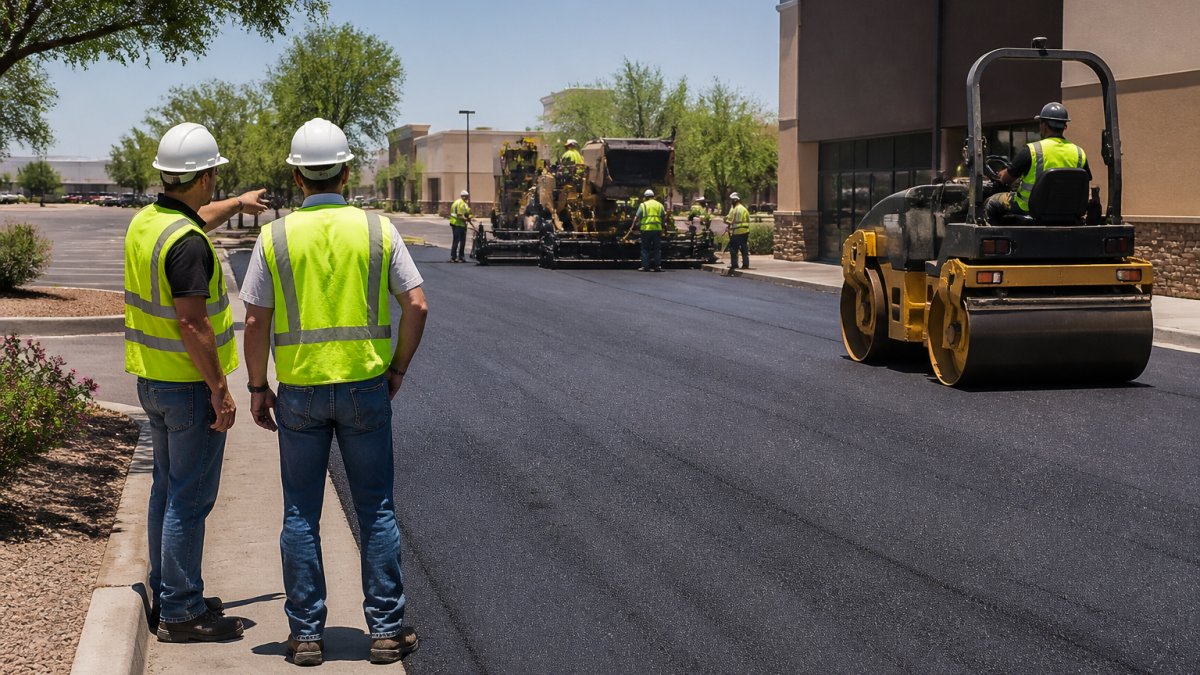
- Roll the surface. Pneumatic rollers press the chips into the binder while it is still tacky.
- Sweep and cure. After curing, crews sweep off loose chips and reopen the surface to traffic.
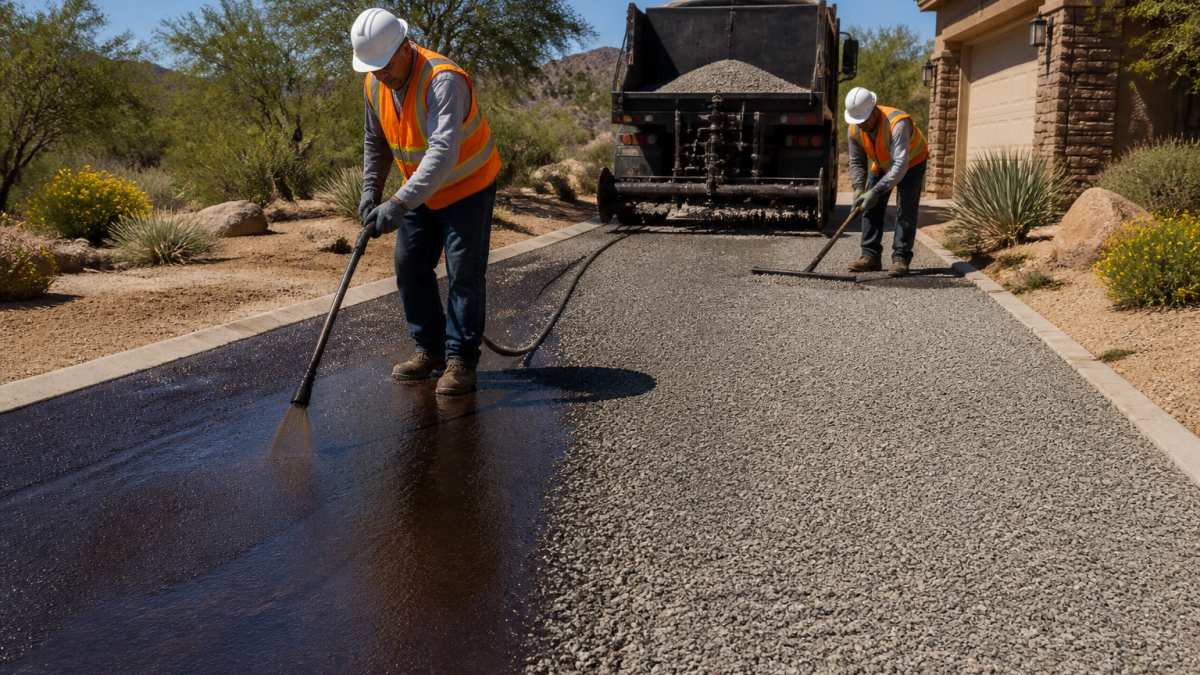
Weather decides the schedule. Emulsion needs warm, dry conditions to cure properly, which is why most Arizona chip seal work happens in the warmer months. Rain during the cure window can wash binder off the surface and force a redo.
The most expensive mistake we see is sealing over a wet or dirty surface. The emulsion will not bond, the chips will strip within a season, and you will pay twice for the same driveway.
Chip Seal Driveway Lifespan and Lifecycle Cost
The lifespan of a chip seal driveway depends heavily on traffic volume, sun exposure, and how well the base was prepared. A double-coat application can extend its service life on a low-traffic rural driveway.
Lifecycle Cost: The Math That Matters
Initial price is only part of the story. The real comparison is what you spend over 20 years to keep the surface serviceable. Here is a worked example for a 1,500-square-foot driveway, using the budgeting bands from the pricing section:
| Option | Initial Cost | Refresh Cycle | 20-Year Cost |
|---|---|---|---|
| Chip seal (single-coat) | $600-$1,180 | Re-seal every 5-7 years | $2,400-$4,700 |
| Chip seal (double-coat) | $1,000-$1,800 | Re-seal every 7-10 years | $2,000-$3,600 |
| Asphalt overlay | $3,000-$6,000 | Mill and overlay every 15-20 years | $3,000-$6,000 |
| Full-depth asphalt | $6,000-$12,000 | Minimal within 20 years | $6,000-$12,000 |
| Concrete | $9,000-$18,000 | Minimal within 20 years | $9,000-$18,000 |
For a sound driveway, chip seal wins on lifecycle cost because a refresh costs a fraction of a full replacement. You can seal a sound driveway two or three times over the years and still spend less than one asphalt overlay. For long rural driveways and low-speed roads, that math is hard to beat.
When Chip Seal Is the Wrong Choice
Chip seal is a wearing course, not a structural fix. It will not rescue a failed base. If the pavement has alligator cracking, rutting, or subgrade failure, chip seal will simply crack along with it and you will have paid for a cosmetic fix. In those cases, an asphalt overlay or full-depth replacement is the correct spend.
What Shortens the Lifespan
- Heavy truck traffic on a light-duty seal
- Poor drainage that keeps water sitting on the surface
- Skipping the crack repair step before sealing
- Applying during the wrong season
- Sealing over a dirty or wet surface
- Deferred re-sealing past the refresh window
Maintenance Between Refreshes
Chip seal is low-maintenance, but not zero-maintenance. A practical schedule includes regular inspection for cracks, potholes, and edge raveling, clearing drainage, and addressing any failed areas. Planning for re-sealing helps maintain the surface over time.
For HOA boards and property managers, the practical takeaway is to budget chip seal as a recurring line item rather than a one-time project. Treating it as maintenance instead of a repair keeps the cost predictable and avoids the emergency replacement that blows the budget.
Federal Highway Administration pavement preservation resources
How to Compare Chip Seal Quotes
Comparing chip seal bids is not about finding the lowest number. It is about finding the bid that accounts for the same scope of work as the others. Two quotes can differ by thousands of dollars simply because one includes prep and the other does not.
Use this checklist when you review each bid:
- Does the quote include crack filling and patching, or is that billed separately?
- Is the aggregate type and size specified?
- Is the emulsion type and application rate stated?
- Does it cover traffic control and cleanup?
- Is there a stated cure time and reopening schedule?
- Is the warranty or workmanship guarantee in writing?
- Does the contractor carry current licensing and insurance?
Ask each contractor to break the bid into prep, materials, labor, and mobilization. Contractors who will not itemize are usually the ones who plan to cut a corner somewhere you cannot see.
At Global Paving, we quote chip seal jobs with that breakdown attached, and we do not pressure anyone into a decision on the spot. If a bid looks too good to be true, it usually means prep was left out.
Conclusion
The hardest part of a chip seal project is not the sealing. It is trusting that the crew will show up on schedule, protect your operation, and fix the root cause instead of the symptom. Global Paving brings over two decades of experience, transparent communication, and a no-pressure approach to every job. We tailor each solution to your budget and traffic needs, and we build surfaces meant to hold up under demanding conditions. Get a quote from Global Paving.
Frequently Asked Questions
How much is chip seal per square foot?
The per-square-foot figure depends on your surface area, the aggregate you choose, and how much prep the base needs. Larger driveways and roads bring the per-square-foot number down because crews spread fixed setup and mobilization costs across more area. Small residential driveways carry a higher rate per square foot for the same reason. Ask each contractor to break their quote into prep, material, and labor so you can compare line by line instead of a single lump sum.
Is chip seal cheaper than asphalt?
Chip seal can be a cost-effective alternative to a full asphalt overlay or new asphalt paving, especially for large surface areas like parking lots, long driveways, and private roads. The approach can be more economical on bigger projects because chip seal uses less material per square foot. That said, chip seal is a surface treatment, not a structural fix, so it only offers cost savings when the base underneath is still sound.
How long will chip seal last on a driveway?
How long a chip seal surface lasts before needing a refresh depends on traffic volume, sun exposure, and how well the base drains. Regular crack sealing and prompt repair of any bare spots can help extend the life of the surface.
What factors affect the cost of a chip seal driveway?
The biggest cost drivers are total square footage, site access for the chip spreader and roller, base condition, and how much prep work is needed before the emulsion goes down. Drainage problems, failed sections, and heavy-traffic areas all add to the prep line. Aggregate choice matters too. Weather also plays a role: crews need dry, warm conditions, so scheduling around monsoon season can affect timing and price.